Brick vs. CMU: How to Choose the Right Masonry Material
A practical, estimator-focused breakdown of clay brick versus concrete block — what each does best, and how the choice ripples through your takeoff.

Almost every wall section you price comes down to a familiar fork in the road: clay brick, concrete block, or some combination of the two. The brick vs CMU decision drives material cost, labor hours, wall thickness, fire rating, and even how your crew stages the job — so getting it right matters long before the first course goes down. The trouble is that brick and CMU aren't really competitors so much as teammates that each shine in different roles.
This guide breaks down where clay brick and concrete masonry units each earn their keep — cost, structure, looks, insulation, fire rating, and install speed — and then walks through what each choice means when you sit down to do the takeoff. Think of it as the conversation a senior estimator would have with a PM before committing a number to the bid.
Brick vs CMU: the 30-second version
Clay brick is a fired-clay unit, usually modular (nominal 4 in. wide), prized for its appearance, durability, and weather resistance. It's most often used as a non-structural veneer — the face of the building — anchored back to a backup wall. Concrete masonry units (CMU, or "block") are larger, hollow, cast concrete units (the workhorse being the nominal 8x8x16) used mostly for structure: load-bearing walls, foundations, shear walls, fire walls, and backup behind veneer.
In short: brick is what people see, CMU is what holds the building up. Plenty of walls use both — a CMU backup wythe carrying the load with a brick veneer face for looks and weather protection. Once you internalize that division of labor, most material decisions get easier.
Cost: unit price isn't the whole story
On a per-square-foot-of-wall basis, CMU is almost always cheaper to build than brick. A single 8x16 block face covers the same area as roughly six modular bricks, so your unit count, mortar joints, and laying time per square foot all drop. Brick veneer carries more units, more joints, and more finicky labor — plus the cost of ties, flashing, weeps, and a backup wall behind it.
But don't stop at the unit price. Brick's higher first cost buys decades of low-maintenance service life and curb appeal that block can't match without additional finishes. If the alternative to brick veneer is CMU plus stucco, paint, or stone, the gap narrows fast. When you bid, compare complete assemblies, not bare units — a "cheap" block wall that needs furring, insulation, and a finish coat may cost more installed than you'd guess.
Structural use: load-bearing vs. veneer
This is the cleanest dividing line. CMU is engineered to carry load. Hollow cells let you place vertical rebar and grout to create reinforced concrete columns inside the wall, and bond beams (knockout or bond-beam block filled with horizontal rebar and grout) tie everything together. That's why CMU shows up in foundations, retaining walls, basements, shear walls, and the structural skeleton of warehouses, schools, and big-box retail.
Clay brick can be structural — structural brick and reinforced brick masonry exist — but in modern North American construction, brick overwhelmingly serves as a veneer. It's anchored to a backup (CMU, steel stud, or wood frame) with corrosion-resistant ties and does no structural work beyond carrying its own weight. If you see brick on the drawings, your first question should always be: is this a veneer, or is it doing structural work? The answer changes your entire takeoff.
Brick is what people see; block is what holds the building up. Price the assembly, not the unit, and the rest of the decision tends to make itself.
Aesthetics, insulation, and fire rating
Looks
Brick wins on appearance, full stop. It comes in a huge range of colors, textures, and bond patterns, ages gracefully, and reads as permanent and high-end. CMU is utilitarian by default, though architectural block — split-face, ground-face, glazed, scored — has closed the gap on projects that want exposed block as a finish. When the spec calls for architectural CMU, watch your pricing: those units cost far more than standard gray block and often require tighter coursing.
Insulation
Neither material is a strong insulator on its own. Bare CMU has modest R-value, and brick even less. Real thermal performance comes from the assembly — rigid insulation in the cavity behind brick veneer, or insulated cells, foam inserts, or continuous exterior insulation with CMU. Both materials do offer good thermal mass, which helps buffer temperature swings. The estimating takeaway: insulation is usually a separate line item driven by the wall section detail, not the masonry unit itself.
Fire rating
Both clay brick and CMU are non-combustible and excellent fire performers, which is a major reason masonry dominates fire walls, stair towers, and separation walls. CMU fire ratings depend on equivalent thickness and aggregate type (lightweight aggregate rates higher for a given thickness), and grouted cells boost the rating further. When a wall is tagged as a rated assembly, confirm the required hourly rating — it can dictate block thickness, aggregate, and grout, all of which hit your numbers.
Install speed and labor
Block goes up faster per square foot. Fewer, larger units mean fewer lifts, fewer joints to strike, and quicker coverage — a skilled mason lays far more wall area per day in 8-inch block than in modular brick. Brick is slower and more labor-intensive: more units, tighter tolerances, and more attention to the finished face since it's exposed.
Labor is where a lot of bids go sideways. Productivity isn't a single number — corners, openings, returns, soldier courses, rowlocks, and special shapes all slow a crew down. A wall that's mostly straight running bond prices very differently from one full of jambs, sills, and accent bands, even at the same square footage. Estimate labor by condition, not by a flat blanket rate. For more on labor traps, see our roundup of common masonry estimating mistakes.
Estimating implications: what changes in your takeoff
Once you know which material is going where, the takeoff details diverge sharply. Here's what to watch for each.
When you're estimating CMU
- Unit count by type. Standard, corner, bond-beam, lintel, and half blocks all carry different counts and prices. Don't lump them.
- Vertical reinforcing and grout. Read the vertical schedule: rebar size and spacing tell you how many cells get grouted. Grout volume is driven by grouted cell count and wall height — easy to underestimate.
- Bond beams and horizontal steel. Count courses of bond beam, then their rebar and grout separately from the verticals.
- Corner and intersection assemblies. They consume extra units and reinforcing and slow labor.
- Bulk packaging. Block is sold by the unit but delivered on cubes; mortar and grout by the bag or cubic yard. Round to real purchase quantities.
When you're estimating brick veneer
- Brick per square foot. Roughly 6.75 modular brick per square foot of wall with standard joints — adjust for the actual unit size and bond pattern.
- Accessories. Ties/anchors, flashing, weep vents, mortar net, and lintels over openings are real money and easy to forget.
- Special units. Soldiers, rowlocks, sills, and bullnose at openings and bands add count and labor.
- The backup wall. Veneer implies a backup — price the CMU, stud, or sheathing behind it as its own scope.
- Bulk packaging. Brick ships in cubes and straps; mortar in bags. Convert to purchase units after you apply waste.
Waste factors
Both materials need a waste allowance — commonly in the low single digits for clean rectangular work, higher for cut-heavy jobs with lots of openings, angles, or special shapes. Apply waste to units, mortar, and grout, and apply it after the base quantity, not baked invisibly into your coverage rates.
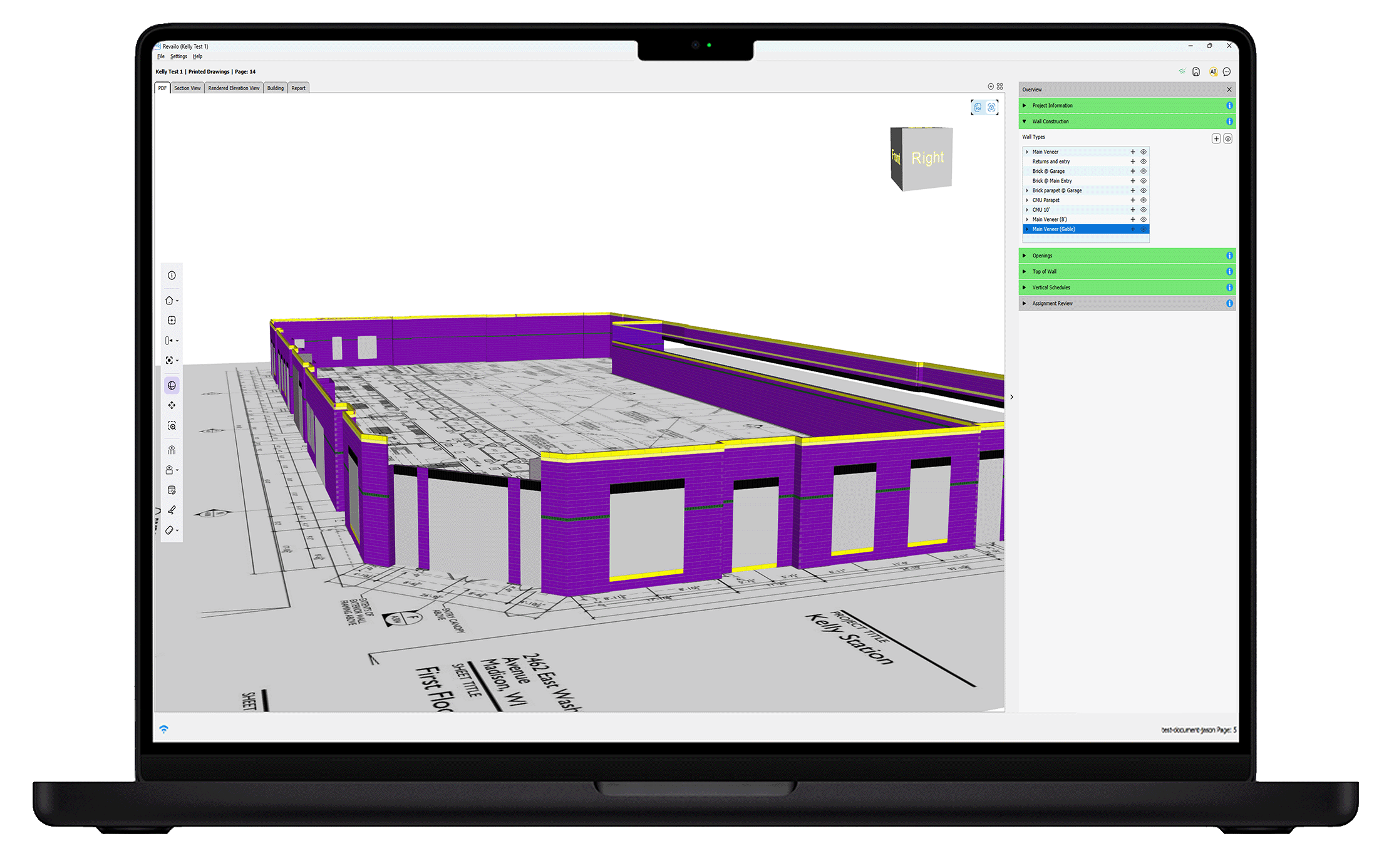
This is exactly the kind of multi-layered counting where a deep-learning takeoff helps: Revailo reads the drawings, separates block types, flags grouted cells against the vertical schedule, and tallies veneer area with openings deducted — so you spend your time on judgment calls instead of clicking every cell. If you want a refresher on the manual workflow first, our guide on how to do a masonry takeoff covers it step by step.
Key takeaways
- Brick and CMU aren't rivals — brick is the face, block is the structure, and many walls use both.
- CMU is cheaper and faster per square foot and carries load via grouted, reinforced cells; brick wins on looks, weather resistance, and longevity.
- Both are non-combustible; CMU fire rating depends on equivalent thickness, aggregate, and grout.
- Insulation lives in the assembly detail, not the unit — price it as its own line item.
- Estimate by condition: corners, openings, and special shapes drive labor more than raw square footage.
- CMU takeoffs hinge on the vertical schedule, bond beams, and grout; brick takeoffs hinge on unit count, accessories, and the backup wall — apply waste after the base quantity for both.
There's no universal winner in the brick vs CMU debate, and the best estimators stop looking for one. Once you read the wall section for what each material is actually doing — holding load or facing the weather — the material choice, the assembly, and the numbers all start to line up. Get that division of labor right, count by condition, and your bids will reflect the building you're actually being asked to build.
Revailo pairs deep-learning takeoffs with 3D visualization so you can bid faster and quote with confidence. Book a live demo and see it on your own plans.