How AI Is Changing Masonry Estimation in 2026
Computer vision is rewriting the masonry takeoff—reading walls, openings, and elevations in minutes—but a seasoned estimator still owns the corners, piers, and judgment calls.
For decades, a masonry takeoff meant a roll of plans, a scale ruler, a digitizer or an on-screen counter, and a long quiet afternoon clicking walls one at a time. The math wasn't hard—it was the volume of it, repeated across every elevation, every opening, every grout cell. In 2026, AI masonry estimation is changing that workflow in a real, measurable way: computer-vision models now read a set of plans and rough in the walls, openings, and quantities before you've finished your coffee.
This article is a straight-talking look at what that actually means for working estimators. We'll cover where AI genuinely speeds up takeoffs today—wall detection, opening recognition, 3D visualization, faster bids—and where it still needs a human hand, because corners, piers, and wall intersections remain the parts the models get wrong most often. No hype, just what the tools can and can't do.
What AI masonry estimation actually does today
The core of modern AI estimating is computer vision: deep-learning models trained on thousands of architectural and structural drawings that learn to recognize the lines and symbols a mason cares about. Instead of you tracing every wall, the model interprets the drawing the way you would—just faster and without losing focus on sheet 47 of 60.
In practice, here's what that buys you on a typical commercial CMU-and-brick job.
Automated wall detection and quantification
The biggest time sink in any takeoff is identifying and measuring linear feet of wall, then converting that to units. Vision models now trace wall lines off the floor plan, pick up wall-type tags, and pull thickness and material from the wall schedule or legend. From linear feet and height, the system calculates net wall area and converts to block or brick counts using your coursing—roughly 1.125 standard 8x8x16 CMU per square foot, about 6.75 modular brick per square foot at a standard bed joint, and so on. The estimator's job shifts from measuring to checking.
Opening recognition and net deductions
Doors, windows, louvers, and storefronts have to come out of gross wall area, and missed deductions are a classic source of overbid quantities. AI tools cross-reference the door and window schedules against the plan and elevations, flag each opening, and subtract it automatically. Better systems also handle the masonry around the opening—lintels, jamb anchors, and the extra cutting—rather than just zeroing out the hole.
Vertical reinforcement and grout
For reinforced CMU, the value is in the schedule. From the structural notes and vertical reinforcing schedule, AI can estimate the number of grouted cells, vertical bar quantities and lap lengths, horizontal joint reinforcement spacing, and bond-beam runs. Grout volume per grouted cell for standard 8-inch block lands near 0.13 cubic feet per foot of height; multiply that across hundreds of cells and you understand why automating it matters. The model gives you a first pass; you confirm the bar sizes and spacing against the engineer's notes.
3D visualization from 2D plans
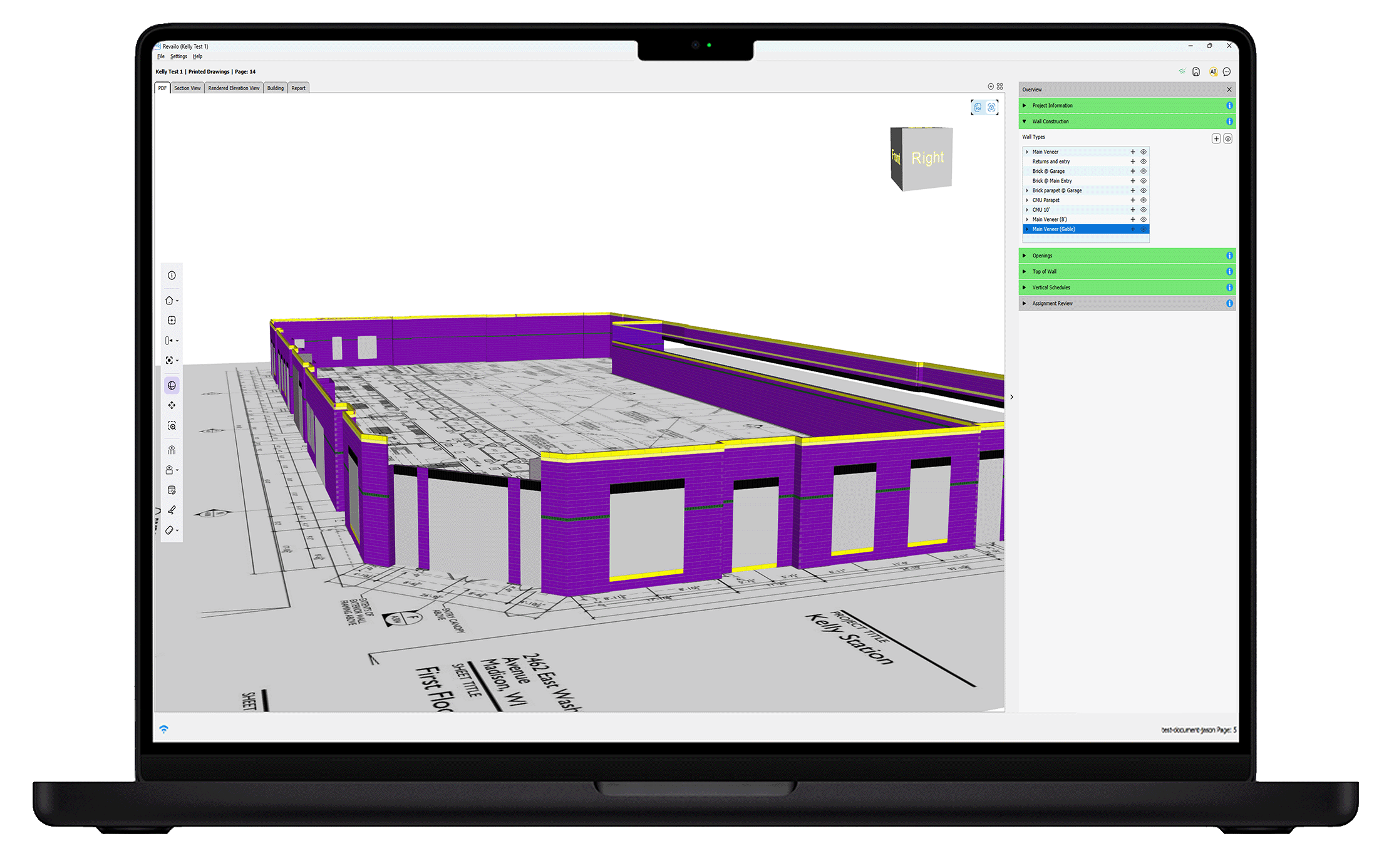
One of the more genuinely new capabilities is turning flat plans and elevations into a 3D model of the masonry. Seeing the building assembled—coursing, openings, control joints, bond beams—catches things a 2D review misses, like a wall that doesn't actually close, a missing return, or an elevation that disagrees with the plan. It's also a strong communication tool when you walk a GC or a foreman through the scope.
Why this matters for bids
Speed is the headline, but accuracy is the real prize. A faster takeoff lets you bid more work, but a consistent takeoff is what protects your margin.
AI doesn't get tired on sheet 50 the way a human does on sheet 5—and that consistency, more than raw speed, is what keeps a bid honest.
When the model applies the same coursing, the same waste factor, and the same deduction logic across every wall on every sheet, you remove the drift that creeps in during a long manual count. That consistency also makes it easier to defend your number in a bid review and to compare apples to apples when you revisit a job a year later. If you want a refresher on the manual process AI is accelerating, our walkthrough on how to do a masonry takeoff lays out the steps the models are learning to replicate.
What AI still can't do well—and where you stay in the loop
Here's the honest part. AI is excellent at the high-volume, repetitive measuring. It is still improving at the parts of masonry that require interpretation, and pretending otherwise will burn you on bid day.
Corners, intersections, and piers
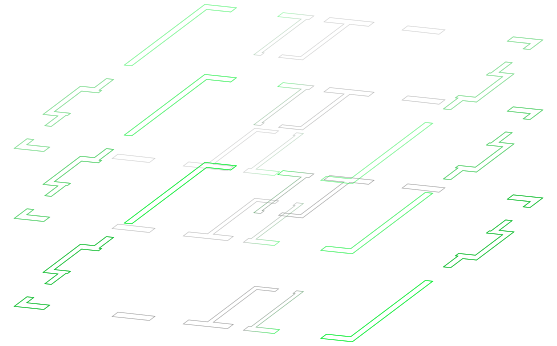
Corner assemblies are where models stumble most. A wall corner isn't just two lines meeting—it's an overlap that affects unit count, requires specific corner units or cutting, and changes the reinforcing detail. Vision models can double-count or miss the overlap at intersections, and isolated piers and pilasters often get read as plain wall. These are exactly the conditions a seasoned estimator scans for first, and they remain a manual verification step.
Bulk packaging and field logistics
AI gives you unit counts; it doesn't always think in cubes and straps. Converting 14,200 brick into the right number of cubes, or block into bands, and then sequencing deliveries against crane access and laydown space, is still a planning judgment. The same goes for scaffolding runs, mortar mixers, and grout pump days—equipment and labor durations come from your production rates and your read of the site, not from the drawing alone.
Waste factors and means-and-methods
A model can apply a default waste factor, but choosing 3% versus 7% depends on the cutting, the bond pattern, the breakage history on that block, and how the job will actually be built. That's experience, and it's yours.
Drawing quality and ambiguity
Garbage in, garbage out still applies. Low-resolution scans, hand-markups, conflicting plan-versus-elevation dimensions, and incomplete schedules degrade any model's accuracy. When the documents are ambiguous, AI guesses; a good estimator knows to RFI it. Sharpening your own ability to spot those conflicts—covered in our piece on reading masonry blueprints—makes you a better partner to the AI, not just a checker of it.
Key takeaways
- Computer vision now automates the high-volume work of a takeoff: wall detection, area and unit counts, opening deductions, and vertical reinforcement and grout from the schedules.
- 3D visualization from 2D plans catches scope conflicts—open returns, mismatched elevations—before they reach the field.
- Consistency, not just speed, is the real win: the same coursing, waste, and deduction logic applied across every sheet protects your margin.
- Corners, intersections, and piers are still the weakest spots; verify them manually every time.
- Bulk packaging (cubes and straps), waste-factor judgment, equipment, labor durations, and RFIs on ambiguous drawings remain human calls.
How to work with AI estimating—not against it
The estimators getting the most out of these tools treat AI as a fast, tireless junior on the team. Let it do the first pass on the bulk quantities, then spend your saved hours on the work that actually moves a bid: corner and pier verification, packaging and logistics, production rates, and the conditions that turn into change orders. Keep your schedules and legends clean, because the model leans on them. And review the 3D model early—it's the cheapest place to catch a problem.
If you're choosing materials or assemblies on a job, the trade-offs we cover in brick vs. CMU still drive the takeoff, AI or not—the tool counts what you tell it to build.
Where this is headed
The trajectory is clear: models are getting better at the hard geometry—corners, intersections, control-joint placement—and tighter at reconciling plans against elevations. Tools like Revailo already automate wall detection, opening recognition, and 3D visualization, and the gap between "AI roughs it in" and "AI nails the conditions" is narrowing each year. What isn't going away is the estimator's judgment. The drawings will always have ambiguity, the site will always have constraints, and someone has to own the number.
For now, the smart play is simple. Let AI take the repetitive measuring off your plate, hold your attention on the corners and the logistics where it still falls short, and use the time you reclaim to bid more work with more confidence. That's not a future promise—it's how the best masonry estimators are already working in 2026.
Revailo pairs deep-learning takeoffs with 3D visualization so you can bid faster and quote with confidence. Book a live demo and see it on your own plans.